Field notes / 06

What the field
is showing us.

A visual index of public BCI work. We bring the signal, hardware, and interface logic into one reading room—no outbound case links required.

Researchers analyzing brain-computer interface data
Neural data analysis / motor decoding reference.
Participant wearing an EEG cap in a research lab
High-density EEG / non-invasive signal reference.
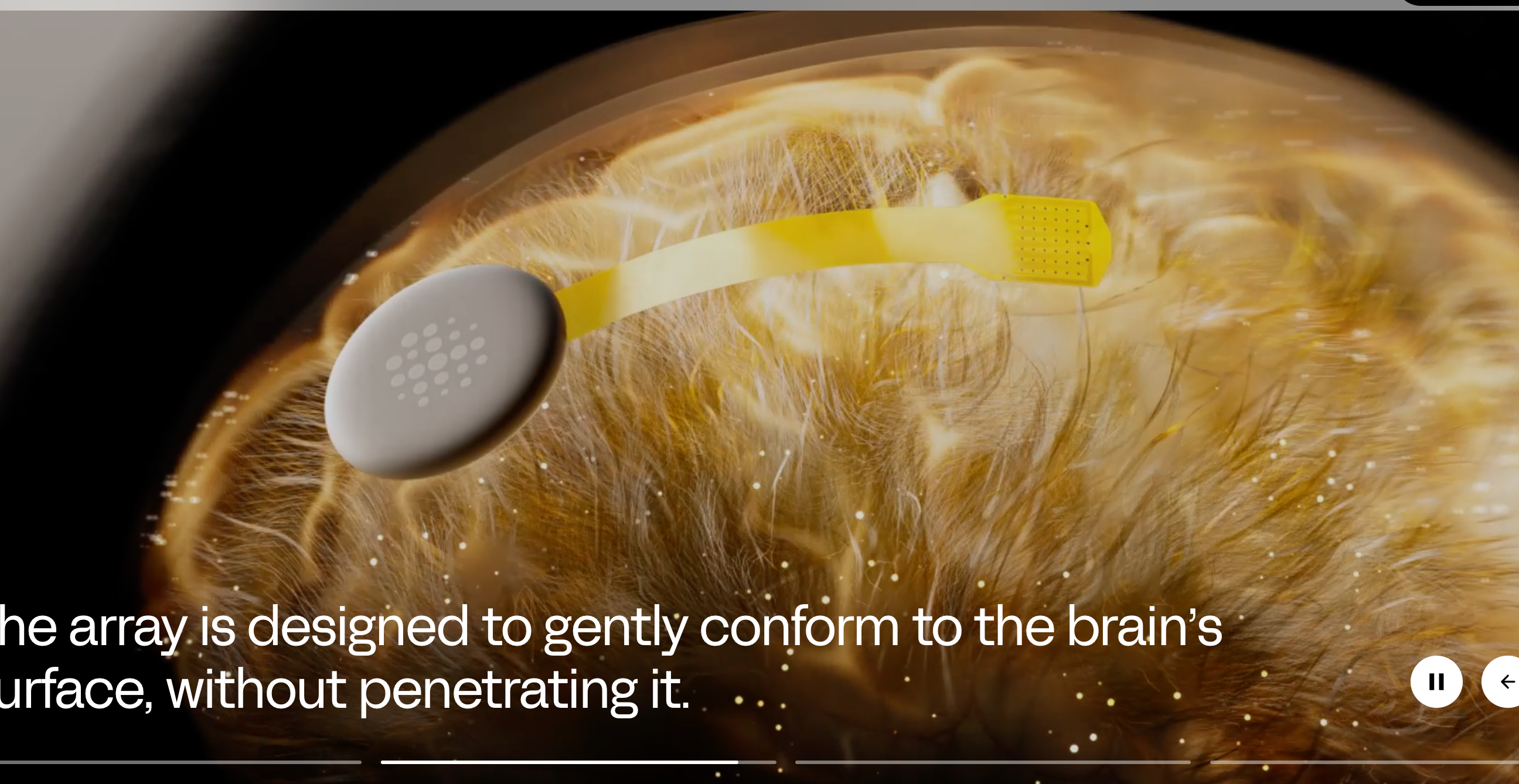
Layer 7 cortical interface concept image
Cortical interface / removable array reference.
CASE 01
NEURALINK / X

High-bandwidth motor intent

Neuralink’s public work makes the control loop legible: neural activity, decoded intent, and a visible action on a screen. The unresolved layer is robustness—how performance holds across sessions, tasks, and uncertainty.

SOURCE MATERIAL
PUBLIC X FEED
CASE 02
SYNCHRON

Less invasive does not mean less complex

Synchron’s endovascular direction shows a different design point: reduce surgical burden while still building a usable control loop with AI, accessibility software, and real-world home environments.

SOURCE MATERIAL
PUBLIC COMPANY DEMOS
CASE 03
PRECISION

Resolution, removability, and the clinical path

Precision Neuroscience frames Layer 7 around high-density cortical recording, minimally invasive deployment, and a path toward practical clinical systems. The visual reference above is now part of our own case-reading surface.

SOURCE MATERIAL
PRECISION LAYER 7
← Back to the main system
Comparison / 07

Different hardware. Same design test.

Signal accesssurface / endovascular / corticaltrade-off
Deploymentwearable / minimally invasive / implantedcontextual
AI layerdecoder + personal adapter + policyclosed loop
Clinical questionperformance, removability, robustnessongoing

The interface is not only the electrode. It is the whole chain from signal to agency.

Case anatomy / 08

Read every system across five layers.

LAYER 01

Access

How close does the interface get to the signal, and what does that demand from the person?

LAYER 02

Resolution

What spatial and temporal detail is available for the intended task?

LAYER 03

Adaptation

How does performance change across sessions, environments, and individual users?

LAYER 04

Action

What does the decoded output control, and can the action be interrupted?

LAYER 05

Clinical path

What has to be true for a compelling demonstration to become a dependable system?

LAYER 06

Evidence

Which claims are public, which are demonstrated, and which remain open questions?

FIELD NOTE 01
NEURALINK

Bandwidth is only the beginning.

High-throughput motor intent is compelling when a cursor moves. The deeper test is whether performance remains stable when the task, interface, and user state all change at once.

REVIEW
ROBUSTNESS
FIELD NOTE 02
SYNCHRON

Deployment changes the product.

An endovascular path can reduce surgical burden while moving complexity into placement, signal quality, calibration, and long-term clinical workflow.

REVIEW
TRANSLATION
FIELD NOTE 03
PRECISION

Resolution meets removability.

A thin cortical interface reframes the trade-off between signal density and clinical practicality. The unanswered question is how the entire system behaves over time.

REVIEW
LONGITUDINAL